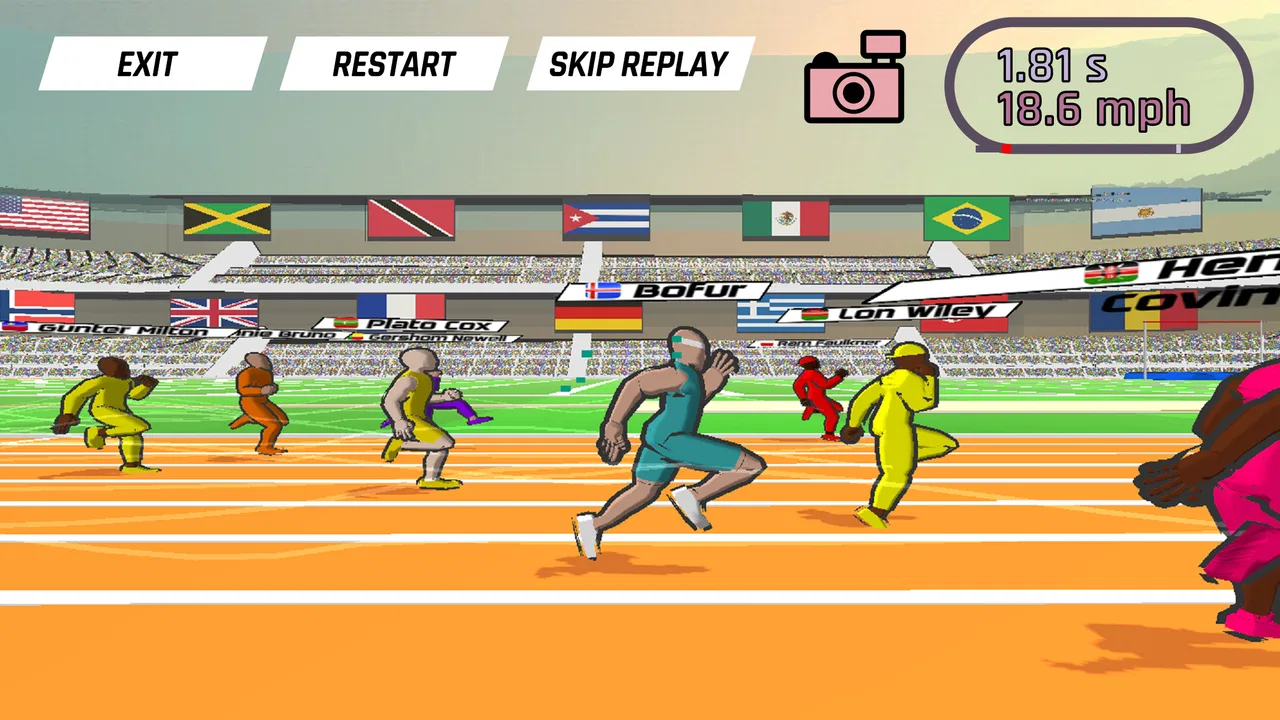
Speed Stars: Running Game
- 4.2
- Rating
- 1.00M
- Installs
- Free
- Price

 Analysis by App-foxy
I went into Speed Stars: Running Game expecting a quick sports title that would be easy to understand and forgettable after a few minutes. Instead, I found a compact track-and-field game built around a simple idea: getting a runner moving quickly is easy to grasp, but keeping that movement controlled is where the challenge begins. It is free to download, rated for Everyone, and made by Miniclip.com, so it is clearly aimed at a broad audience rather than a specialist sports crowd.
The appeal is immediate. You are not managing a full team, learning a large rulebook, or waiting through a long tutorial before doing anything interesting. The focus is on sprinting and hurdling, with short attempts that suit a spare moment. At the same time, the controls ask for more attention than a typical button-mashing arcade game. My first few runs felt clumsy, but that awkwardness became useful: every mistake showed me that speed alone was not enough.
What the first run really feels like
The game’s strongest quality is its directness. A race starts with very little between you and the track, and the objective is obvious even if the best technique takes practice. That makes it a good choice when I want a sports game I can understand without reading a long explanation. It also makes the title approachable for younger players, while adults can still find a satisfying rhythm in trying to improve a poor run.
You May Also Like

 Google Keep - Notes and lists
Google Keep’s Quiet Growth Shows the Appeal of Simpler Notes
As mobile work gets busier, Google Keep keeps winning a simple contest: capture a thought quickly, find it later, and get on with the day.

 Blood Strike: 2.5 Anniversary
Blood Strike’s Loadouts Turn Every Drop Into a Tactical Gamble
A close look at Blood Strike’s custom loadouts: how fast access to signature weapons reshapes its battle royale rhythm, rewards preparation, and narrows the gap between fights.

 Pandora - Music & Podcasts
Pandora’s Music Is Easy to Start, but Harder to Recover
Pandora’s strength is its low-effort path from a seed to a station. Its weak spot is how much confidence it asks you to place in connection, setup, and quiet recovery.

 8 Ball Pool
 Is Built on Rivalries, Rematches, and Routine
A close look at the rivalries, rematches, shared routines, and unanswered safety questions that turn a quick pool match into a persistent mobile community.

 Samsung Music
’s Quiet Strength Is Playing What You Already Own
Its reach comes less from spectacle than from dependable access to a personal library. That simplicity is both the app’s strongest retention engine and its ceiling.

 AccuWeather: Weather Radar
AccuWeather Review: A Quick, Clear Forecast for Everyday Decisions
For everyday plans, the best forecast is the one you can understand quickly. AccuWeather makes rain timing, radar, and local conditions easy to act on, with a few trade-offs.
More From Our News Desk



The basic experience is more about timing and coordination than realistic athletics management. I am not choosing training schedules or arranging a roster. I am trying to make the runner accelerate, maintain a clean rhythm, and avoid throwing away a promising attempt. That distinction matters when comparing it with larger sports games. If you want a detailed simulation, this will feel intentionally small. If you want a fast challenge that gets to the action, its limited scope is a benefit.
There is also a useful tension between short sessions and repeated attempts. A single race does not demand a large block of time, but one imperfect movement can make me want to try again immediately. This loop works especially well on a phone because I can play while waiting for a bus or during a short break, then stop without losing an evening to a complicated campaign.
The public response gives the game a reasonable level of visibility: it has an average rating of 4.0 from around 5.2 thousand ratings, with over a million installs. I would not treat those figures as a guarantee that everyone will enjoy the controls, but they do match my impression that the concept is easy to pick up. The game has enough friction to create a learning curve without burying the player in systems.
Installing it and getting comfortable
Speed Stars: Running Game is free, although optional in-app purchases range from $0.99 to $7.99 per item. I would begin with the free experience and decide later whether anything extra is genuinely useful to me. That approach is particularly sensible here because the core question is not whether the game looks attractive in a store preview; it is whether its movement feels comfortable in my hands.
The game supports Android 7.0 and later, which covers a wide range of devices. On a first launch, I would keep the opening session focused on learning rather than immediately chasing a perfect time. The most important adjustment is physical: I need to hold the phone securely, keep my fingers relaxed, and avoid making large frantic movements when a smaller correction would do.
That may sound minor, but it changes the experience. When I grip the device too tightly, I react late and overcorrect. When I treat each input as a measured part of the runner’s rhythm, the race becomes easier to read. This is one of the first non-obvious lessons in the game: better results often come from calmer hands, not faster tapping.
I also recommend playing the first few attempts with notifications and other distractions out of the way if possible. The races are short, but their timing is unforgiving enough that a glance away can ruin an otherwise good effort. The game is casual in length, not necessarily casual in concentration.
Finding the first meaningful success
For a new player, the first worthwhile goal should not be a record. It should be completing a run that feels deliberate from start to finish. I found that success more useful than immediately judging the game by my earliest result. The opening attempts can look messy because I am learning how much input is needed and when to make it.
My practical method is to divide the race into phases. At the start, I concentrate on establishing a controlled rhythm instead of trying to create maximum speed instantly. Once the runner is moving consistently, I focus on maintaining that rhythm. Near a hurdle, I stop thinking about the entire race and pay attention only to the next movement. After clearing it, I return to the running pattern rather than reacting emotionally to the previous jump.
This approach produces a better first success because it turns a vague challenge into several small decisions. It also reveals why simply pressing harder is not a reliable solution. A fast opening can be wasted by poor timing later, while a slightly slower but steadier attempt gives me a clearer foundation for improvement.
One useful habit is to change only one thing between attempts. If I alter my starting rhythm, hand position, and hurdle timing all at once, I cannot tell what helped. Instead, I might keep the opening identical and adjust only the approach to the next obstacle. That makes the game feel less random and gives each retry a purpose.
Another practical tip is to judge mistakes by their location. If I fail near the beginning, I probably need to work on the initial rhythm. If the run feels good until an obstacle, the issue is likely timing rather than overall speed. This sounds obvious after a while, but it prevents the common mistake of restarting without learning anything from the previous attempt.
Why the controls can confuse newcomers
The biggest source of early frustration is that the game looks simpler than it feels. A player may assume that rapid input automatically means rapid progress. In practice, the important question is whether the inputs arrive in a useful pattern. I had to stop treating the race like a test of reflexes alone and start treating it like a coordination exercise.
Hurdles add another layer of confusion. They are not just interruptions placed on a straight run; they change what I need to watch. If I focus entirely on speed, I can approach an obstacle without enough control. If I become too cautious, I lose the momentum that made the attempt promising. The trade-off is what gives the game its character, but it can also make the first sessions feel less forgiving than expected.
I would also avoid blaming the game after one bad attempt. Short races encourage instant retries, and that can create a loop where I repeat the same mistake with more impatience each time. A better response is to pause briefly, identify the moment that went wrong, and restart with a single adjustment. This is especially important for children, who may understand the objective immediately but need time to connect timing with results.
Players coming from endless runners should set their expectations carefully. Endless runners often reward reacting to a stream of changing hazards, while this game feels more focused on repeating a controlled athletic action. Players coming from full console sports simulations may have the opposite reaction: the direct controls are refreshing, but the narrower structure may feel too lightweight.
That comparison helps identify the right audience. I would recommend it to someone who enjoys improving a small skill through repeated attempts. I would not choose it for a player who needs team management, a broad career mode, deep customization, or a long narrative reason to continue. Its satisfaction comes from execution, not from building a large world around the sport.
Making a short session worthwhile
A realistic everyday use case is a ten-minute break between tasks. I can launch the game, complete a few attempts, and stop after reaching one clean section of the race rather than feeling obligated to finish a lengthy match. The compact format also works well when I want something more active than a puzzle but less demanding than a full action game.
For a longer session, I would use a simple practice structure. I might spend the first attempts observing my timing, then focus on one weak section, and finish by trying a complete run without changing technique halfway through. This prevents the session from becoming a blur of restarts. It also gives me a clear answer to the question, “Did I improve?”
Playing with sound or without it can change how I concentrate, so I would try both rather than assuming one is better. If audio helps me notice the rhythm, it can support consistency. If it becomes distracting, silent play may make the timing easier to follow. I see this as a personal adjustment rather than a hidden advantage, but it is worth testing early.
The game is also suitable for passing the phone between friends or family members for informal challenges, provided everyone is comfortable with the same control style. The fun comes from comparing attempts and discussing technique, not from needing a complicated multiplayer setup. That makes it a pleasant social time-killer, though players seeking a full competitive online sports environment should look elsewhere.
Where the free model fits
Because the game is free to play and includes optional purchases, I would approach the store elements with the same restraint I use in any casual title. The core test is whether I enjoy the running and hurdling loop without spending money. If I do, I can consider purchases as optional support or convenience, but I would not install it expecting that buying something will replace practice.
This is an important trade-off. A player who enjoys skill-based repetition may see spending as unnecessary because improvement comes from better timing. Another player may prefer paying for extras if they want to move through the experience more quickly. Neither approach changes the central point: the game’s most valuable progress is the understanding gained from each attempt.
I also like that the age rating is Everyone, which makes the title easier to consider for a shared family device. Adults should still guide younger players around purchases, as they would with any free game that offers optional items. The rating tells me the content is broadly accessible, but it does not remove the need for sensible device and account habits.
How it compares with other sports choices
Compared with a football or basketball game, Speed Stars: Running Game removes the complexity of teams, tactics, and long matches. That makes it faster to learn and easier to fit into a short break, but it also means there is less variety in the type of decision I make. The game is about refining movement rather than reading a whole field.
Compared with an arcade endless runner, it feels more deliberate. I am not simply trying to survive as the environment accelerates. I am trying to repeat a specific athletic pattern and handle hurdles without losing control. That gives each retry a clearer training purpose, although players who enjoy constant novelty may find the focused structure repetitive.
Compared with a serious track-and-field simulation, it is much more approachable. I can start playing without learning a large set of events or managing detailed athlete attributes. The cost of that accessibility is depth: anyone looking for a complete athletics package may eventually want a broader game. For me, the narrow focus is exactly why it works as a quick phone experience.
That comparison also explains who should skip it. If I want a story, exploration, a large collection of sports, or a strong progression system, this would not be my first choice. If I want a small, repeatable test of timing that I can understand in moments, it is a better fit than many larger alternatives.
What to try after the first clean run
Once I can complete a run without feeling lost, I would stop chasing random improvements and set a specific target for the next session. That might mean making the opening more consistent, approaching hurdles with less panic, or finishing without changing rhythm after a mistake. Specific goals make the short format feel more meaningful.
I would also leave a little space between serious attempts. The game encourages immediate retries, but fatigue can make my hands less precise and my decisions more rushed. A short pause can be more productive than forcing another attempt. This is one of the clearest trade-offs in the design: repetition builds skill, but mindless repetition builds frustration.
Version 2.49 is the current version, and the game was released on March 22, 2023. Those details matter mainly when checking compatibility and deciding whether the experience suits a device that runs Android 7.0 or newer. I would keep the app updated through the normal store process, especially if I notice technical behavior that changes between sessions.
After spending time with it, I see Speed Stars: Running Game as a focused sports game rather than a complete athletics simulation. Its best moments come when a previously awkward movement suddenly becomes consistent and I finish a run knowing exactly what improved. Its weakest moments come when I want more variety or when the controls feel unforgiving before I have learned their rhythm.
My recommendation is straightforward: try it if you want a free, compact running challenge and enjoy improving through repeated attempts. Give it a few calm sessions before deciding, because the first run does not show its full appeal. Skip it if you need deep management, extensive content, or a more forgiving pick-up-and-play experience. For the right player, the real reward is turning a clumsy first attempt into a controlled run, and that is enough to make this small sports game worth keeping around.
FAQs for Speed Stars: Running Game
01What is Speed Stars: Running Game about?
Speed Stars: Running Game is an engaging and competitive running simulator where players can challenge themselves on various tracks. You can customize your runner, improve their skills, and compete in different events. The game offers a mix of strategy and reflex-based gameplay, making it both fun and challenging.
02Is Speed Stars: Running Game free to play?
Yes, Speed Stars: Running Game is free to download and play. However, the app offers in-app purchases, which can enhance the gameplay experience. These purchases range from cosmetic items to boosts that can help you progress faster. It's possible to enjoy the game fully without spending any money.
03What are the main features of Speed Stars: Running Game?
The game features a variety of running tracks and events, customization options for your character, and a skill improvement system. Players can compete in global leaderboards, participate in time-limited events, and enjoy realistic running physics. The game also supports both solo and multiplayer modes for diverse gameplay.
04Are there any ads in Speed Stars: Running Game?
Yes, there are ads present in Speed Stars: Running Game. These ads help keep the game free for users. However, you can choose to remove ads through in-app purchases if you prefer an uninterrupted experience. The ads typically appear between races or when accessing certain features.
05Is an internet connection required to play Speed Stars: Running Game?
An internet connection is not strictly necessary to play Speed Stars: Running Game, as you can enjoy many features offline. However, an internet connection is required for accessing multiplayer modes, syncing progress, and participating in online events. For the best experience, it’s recommended to have an internet connection available.
Pros
- Engaging and realistic running mechanics.
- Wide variety of characters to unlock.
- Challenging levels with increasing difficulty.
- Smooth and responsive controls.
- Visually appealing graphics and animations.
Cons
- In-app purchases can be expensive.
- Occasional ads can interrupt gameplay.
- Limited customization options.
- Requires internet for some features.
- Some levels can feel repetitive.

Speed Stars: Running Game
Gallery